The case for Jaime Henry: The data AFLW clubs cannot afford to ignore

WITH the AFLW Preseason Draft taking place tomorrow night, there is one name that needs to be on every club’s list.
Jaime Henry is the best player in the WAFLW this season on sheer numbers alone. To have the most disposals and most tackles in the competition at the same time is an incredible feat – while also being amongst the top handful of markers in the competition – and it has all come down to the incredible transformation she made 18 months ago returning from Victoria.
It is easy to forget that Henry is still 20 years old and getting better. If her name is not read out at tomorrow night’s draft, she will be turning out for Swan Districts for another season while the competition she is clearly ready for passes her by.
This is the case – built on four years of data, physical performance numbers that will make your sports scientist sit up straight, and a transformation story that is as compelling as any in the women’s game – for why Henry’s past knocks should not dictate her future.
Who she is
Jaime Henry
Club: Swan Districts
Position: Inside Midfielder
Height: 176cm
DOB: 05/10/2005
Henry is a natural ball-magnet of a midfielder who has evolved from a versatile player – spending time as a tall defender and midfielder hybrid role in her early years – into a pure inside midfielder who simply does not stop. She represented Western Australia at the Under 17 Championships in 2021 and at Under 18 level in 2022 and 2023, was a member of the AFLW Academy as a top-ager in 2023, and has been playing WAFLW football since 2022. She is left-foot dominant with a penetrating kick and clean hands, and what has changed most dramatically is the engine underneath all of that natural ability.
The on-field arc
The statistics across Henry’s career tell the story of an athlete building deliberately, purposefully and with remarkable results.
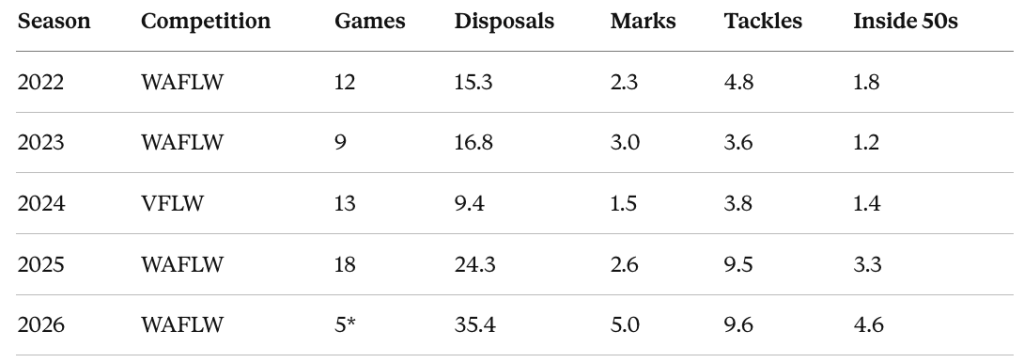
The jump from 2023 to 2025 alone is significant. But what Henry has done in 2026 is in a different stratosphere. Her disposal average has leapt from 24.3 to 35.4. Her marks have nearly doubled. Her tackle average of 9.6 per game – combined with 5.8 clearances – confirms she is not a peripheral accumulator but a genuine contested-ball engine who is influencing the game’s biggest moments.
She has gone past 30 disposals in all five games this season. Henry is being tagged. She is getting 35 anyway.
The standout performance of the season came in Round 5 against Perth – a game in which the opposition identified her early and sent a specific opponent to follow her all day. Henry finished with 39 disposals, 16 tackles, six marks, five clearances, five inside 50s and four rebound 50s at 64.1 per cent disposal efficiency. The opposition gameplan centred on stopping her. It produced one of the best individual performances the WAFLW has seen.
She also had 38 in Round 2 against South Fremantle and 37 in Round 4 against West Perth. That is three of her five games this season above 37 disposals, in a competition where being consistently tagged is the price she pays for being the best player on the ground every week.
Victoria, and the moment everything changed
Henry’s top-age year in 2023 ended without a call on draft night. The feedback was pointed – her 2km time-trial came back at over nine minutes, and concerns around her speed and endurance were real. She was a talent, but one that clubs felt they could not select on physical grounds.
She never looked for excuses. She had been carrying the effects of a significant corkie injury from 2022 into her draft year. She knew what the numbers said, and she made a decision.
Henry relocated to Victoria and played 13 games for the Western Bulldogs in the VFLW in 2024. The numbers there are modest, but that was never the point of the year. She played every game of the Bulldogs’ season and was left out of their grand final squad. For most players, that is where the story ends.
“I think that just having that pivotal moment I was like, ‘alright well I want to be a professional athlete and I know that I have the determination for it — so what can I actually do to get there?'” Henry told Rookie Me Central last December.
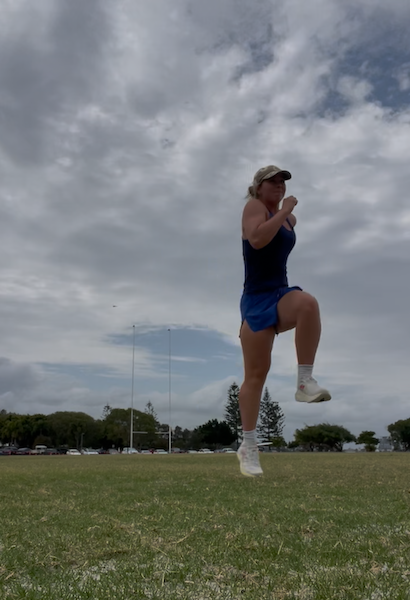
She came back to Perth and invested in a personal strength and conditioning coach and nutrition support – out of her own pocket, entirely self-driven. She dropped 10 kilograms. She ran. Her first 2km time-trial back clocked 9:42. A month later she had shaved over 30 seconds off it. By December 2025, she ran 7:53 — almost two full minutes faster than where she had started.
“I’ve sacrificed a lot in the past year just to get to where I want to be,” she said. “And I’m far from finished.”
The hallmark of Henry’s mindset is not the headline result but the detail in how she got there.
“Doing your sprints up and back — some people might turn just before the cone, but it’s like no, I’m going that extra inch to get to the cone and go around it,” she said. “Those are little one percenters, because then that gives me confidence going into a game knowing that I haven’t cut corners.”
The physical numbers: Where it gets serious
On-field statistics confirm what Henry is doing. Physical data explains how she is doing it — and why the knock that defined her draft year no longer applies. In 2025, Henry’s peak metres-per-minute figure was 95.95. Her range was between 80 and 90 metres per minute. On a typical day, her total distance averaged 8,168.47 metres per game, with a sprint distance of 1,380.29 metres. She hit a top speed of 26.9km/h – second highest in the Swan Districts midfield group. Those were already improved numbers from an athlete still building.
In 2026, those figures have been rewritten entirely.
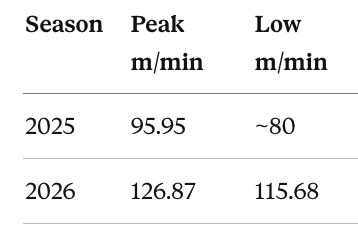
Her lowest metres-per-minute figure this season – 115.68 – is higher than her peak from last season. That is not a misprint. The floor of her 2026 physical output sits more than 20 metres per minute above the ceiling of her 2025 performance. She has not had a bad day this year by her own previous standard. Every game she has played in 2026 has exceeded what was, 12 months ago, her best.
The Perth game – the 39-disposal, 16-tackle performance – was also her best physical output of the season. Henry covered 10,315.42 metres of total distance while sprinting 1,239.91 metres, representing 12.02 per cent of her total workload at sprint speed. Her metres-per-minute figure for that game was 126.87. She is also consistently hitting top speeds of around 25km/h across the season — a player once flagged for lacking pace is now hitting elite numbers with regularity.
To put the shift in context: in 2025, Henry’s range was 80 to 95 metres per minute. In 2026, her range is 115 to 126. She is covering more than 40 extra metres per minute at her peak, and more than 20 extra metres per minute on her worst day. The athletic transformation is not a claim — it is a documented, measurable fact.
The remaining knock, and why it matters less than you think
The one honest assessment that remains from the Round 1 Player Focus – which noted that explosiveness out of the stoppage is still the primary area where Henry does not yet have the speed to break away cleanly – is worth addressing directly.
It is real. Henry is not a player who wins a clearance and burns opponents over 20 metres. That is not her game, and it is unlikely to become her game. But the context matters enormously. She is averaging 5.8 clearances per game without that explosive burst. She is winning 9.6 tackles. She is finding the ball 35.4 times a game while opponents tag her specifically because they know she will if they let her run free.
Henry cannot be brought down easily, she disposes cleanly with an opponent hanging off her left side, and her football nous – which has never been in question – means she rarely puts herself in a position where that burst of pace is the only option available.
The knock was a reasonable concern for a 17-year-old in 2023. In 2026, it is a minor limitation in a profile that has become genuinely elite. Every player selected at AFLW level has areas to develop. The question for clubs is whether the strengths outweigh the limitations – and with Henry, that answer has become increasingly straightforward.
The verdict
In December last year, Henry said: “Looking back in my draft year, if I was where I am now physically and mentally, I personally feel like I’d be on a list.”
She was right then, and the player she was in December is not even the player she is now.
The AFLW Preseason Draft takes place tomorrow night. Henry is playing for Swan Districts today and will add another game to a statistical ledger that already represents one of the more dominant individual seasons the WAFLW has produced. She is the best player in the competition. She has done everything asked of her and more — transformed her body, her fitness, her physical output, and her on-field numbers — driven entirely by her own determination and her own resources.
The data does not need editorial assistance. It makes its case plainly. The only question that remains is whether a club is willing to answer it.

Purple Patch: Magic Marsh turns it on in stunning first term
WITH a Talent League Girls Grand Final spot up for grabs, Dandenong Stingrays’ top-ager Scarlett Marsh produced one of the most impact-per-possession quarters in the hottest of heats to provide her team with a blistering start in Saturday’s preliminary final. The Stingrays booted 4.4 (28) to 0.2 (2) in the opening quarter against the Eastern […]
2026 Talent League Girls R20 notes: Gippsland Power vs. Oakleigh Chargers
EIGHT goals between Bailee Martin and Scarlett Bown helped Oakleigh Chargers post a comfortable 41-point victory, as the top ranked metropolitan side booted 10 of the first 12 goals at Morwell Recreation Reserve. The Chargers proved too good in the end, getting up 10.6 (66) to 3.7 (25) in a memorable performance. We took note […]
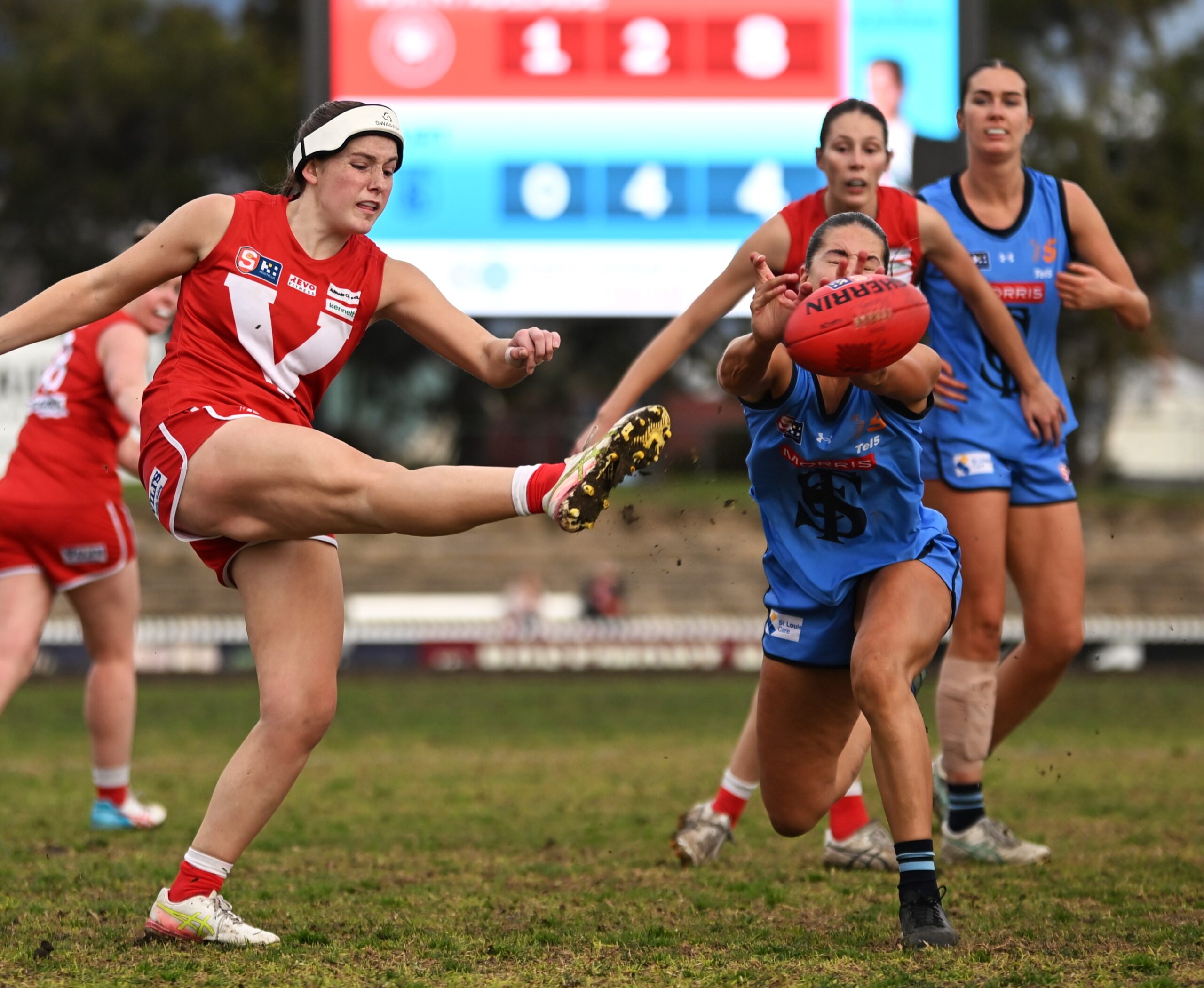
State Academy notes: 2026 SANFLW – Round 14
ROUND 14 of the 2026 SANFL Women’s season produced an outstanding final stanza for four of the eight sides, with the State Academy contingent continuing to build their draft stocks across the four games. We took note of how each of the Academy members performed in the latest round of action. All notes are the […]
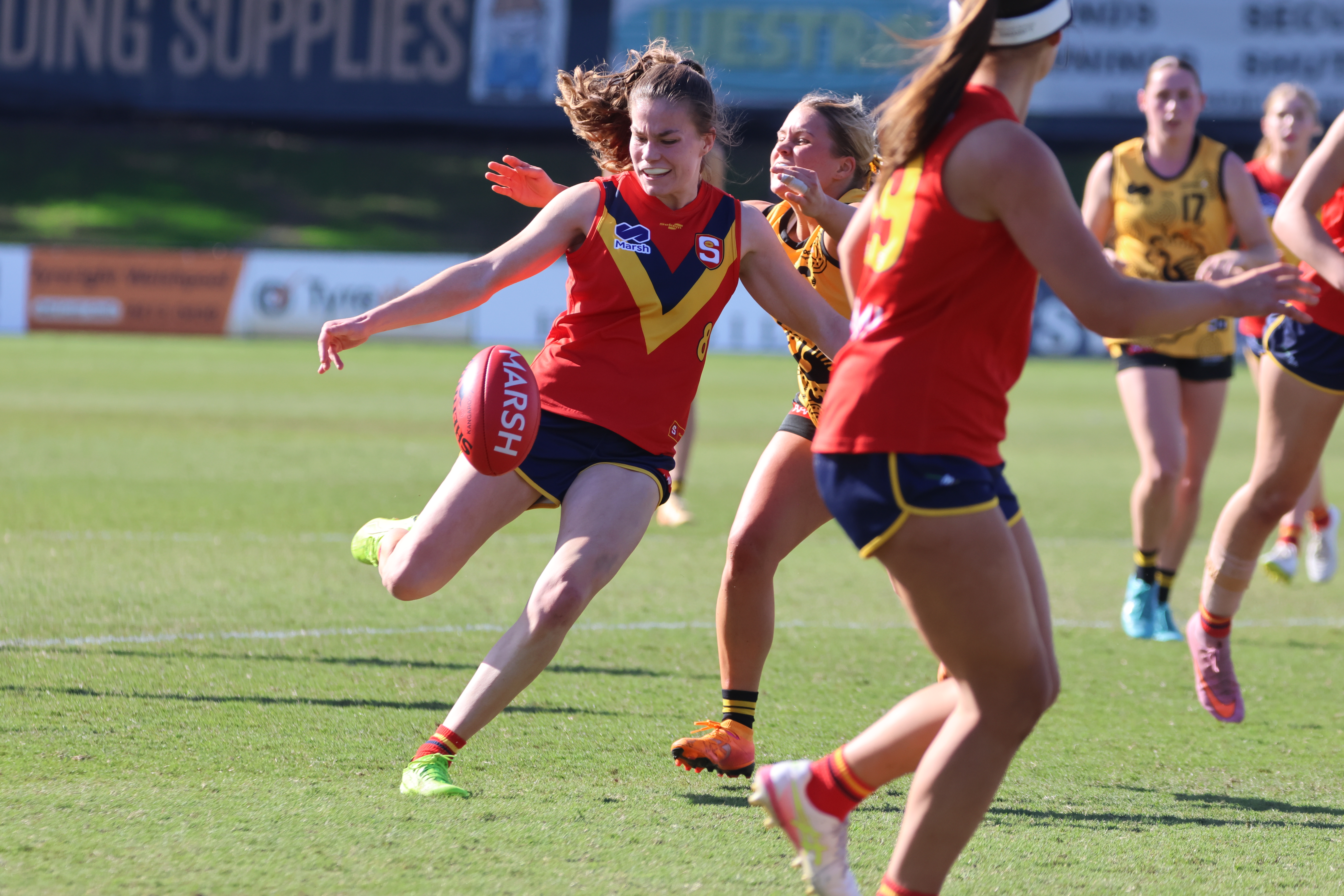
2026 SANFLW Player Focus: Emily Mableson (West Adelaide)
DESPITE a difficult final-round result for West Adelaide, Emily Mableson stood tall as the Bloods’ best afield in their 9.4 (58) to 1.8 (14) loss to South Adelaide. The top-age prospect worked tirelessly between midfield and defence, collecting 32 disposals, five clearances, five inside 50s and five rebound 50s in a complete all-ground performance. Mableson […]
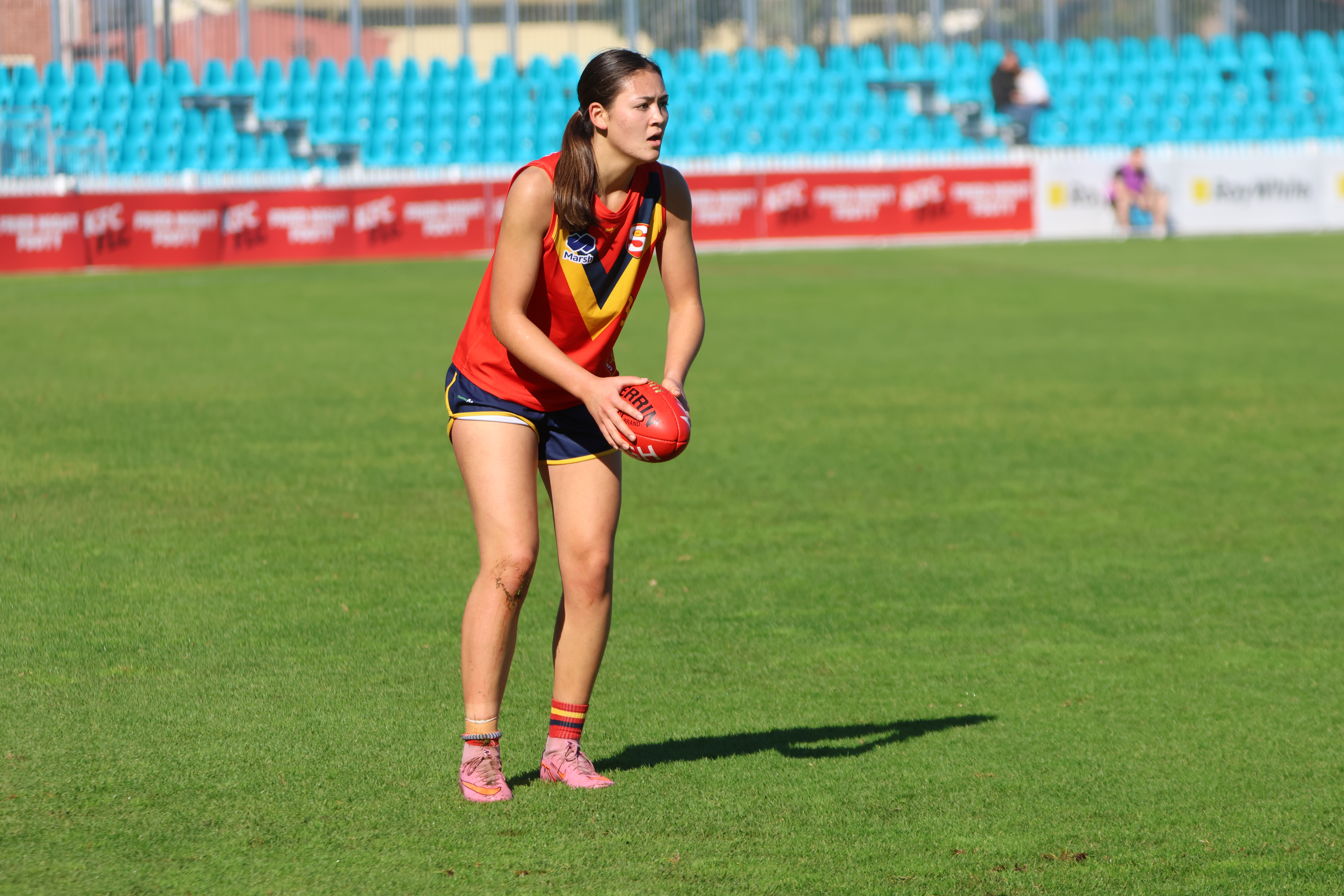
2026 SANFLW Player Focus: Miyu Endersby (Central District)
ENDING her SANFLW home-and-away campaign with a record-breaking performance, Miyu Endersby controlled the ruck contest as Central District defeated Glenelg 6.9 (45) to 4.6 (30) in Round 14. The 179cm top-age tall amassed a SANFLW-record 54 hitouts, while also working hard around the ground with 15 disposals, six marks and five tackles in the Bulldogs’ […]
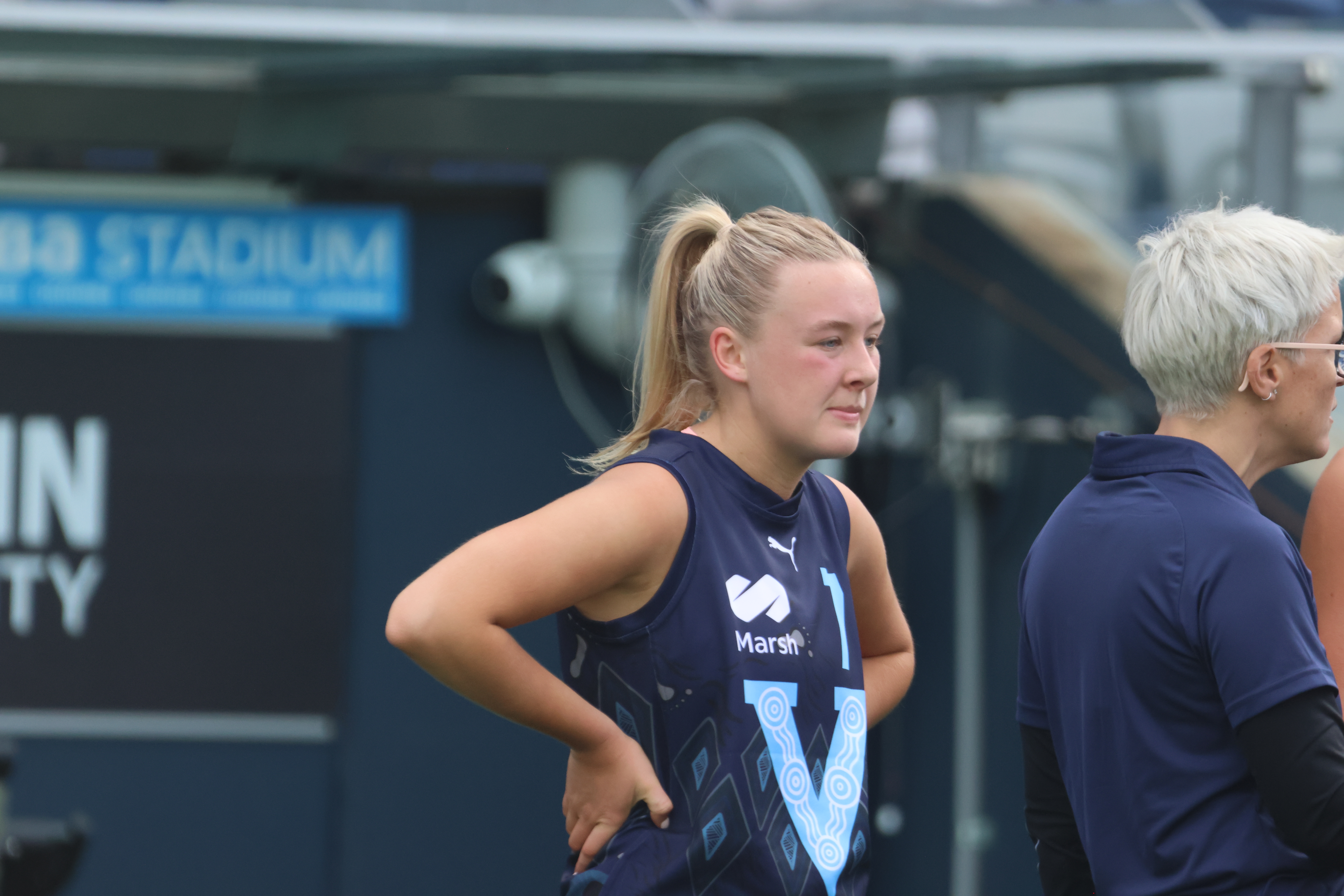
2026 TLG Player Focus: Leni Lockyer (Oakleigh Chargers)
OAKLEIGH Chargers took care of Calder Cannons at Warrawee Park on Saturday, running out 53-point winners, 10.13 (73) to 2.8 (20), in Round 19 of the Talent League Girls. Among the more understated contributors was Leni Lockyer, who spent the full four quarters in defence and finished with 20 disposals, five marks and three rebound […]
2026 SANFLW Player Focus: Lucy Moore (Woodville-West Torrens)
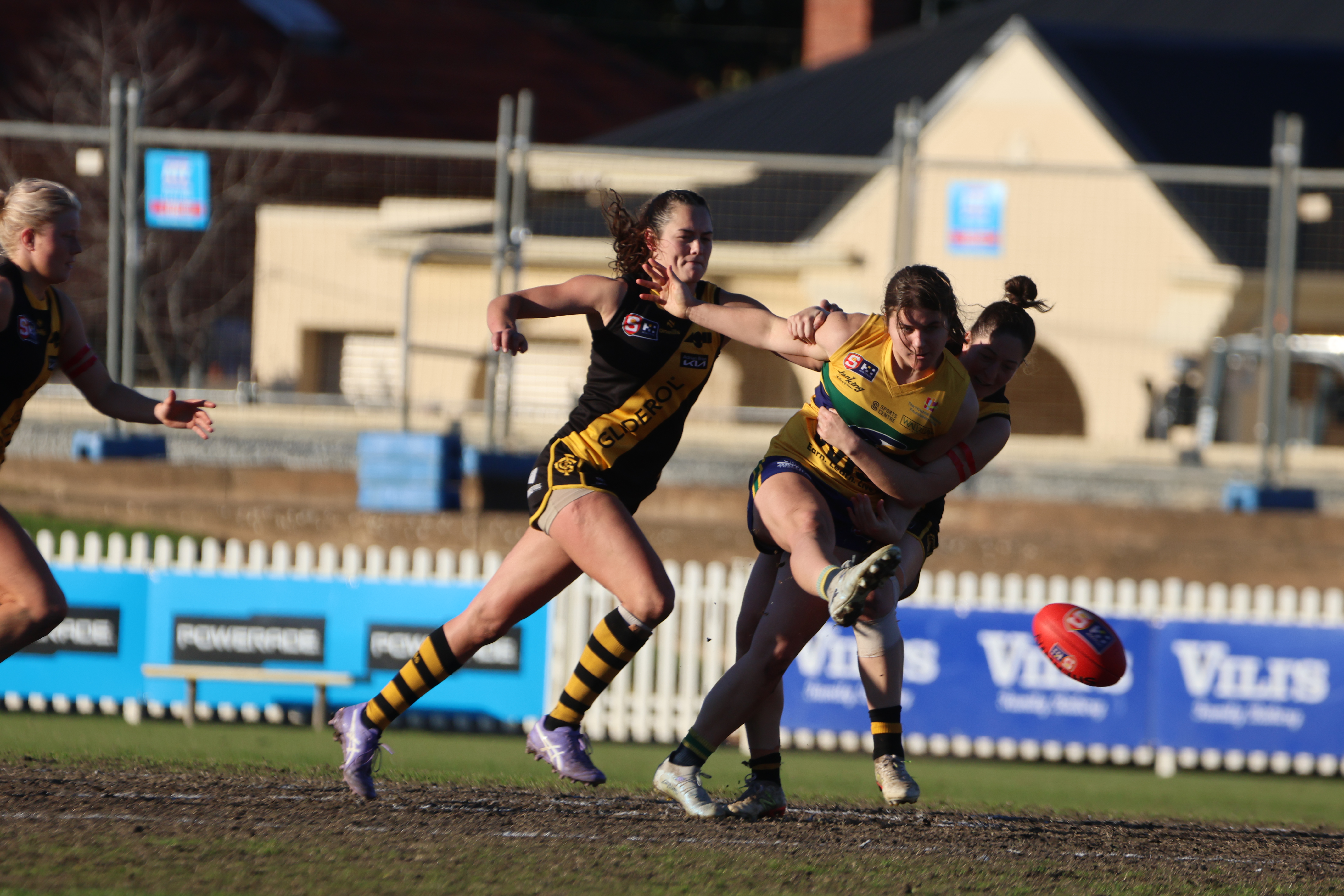
ENJOYING a wonderfully consistent top-age season, Woodville-West Torrens’ Lucy Moore was again the engine room presence Woodville-West Torrens needed as the Eagles accounted for Glenelg 5.7 (37) to 2.5 (17) at Maughan Thiem Kia Oval in Round 13, locking away top spot and a home final. Moore was our SANFLW Player Focus for Round 13. […]
2026 TLG Player Focus: Skylah McPherson (Murray Bushrangers)
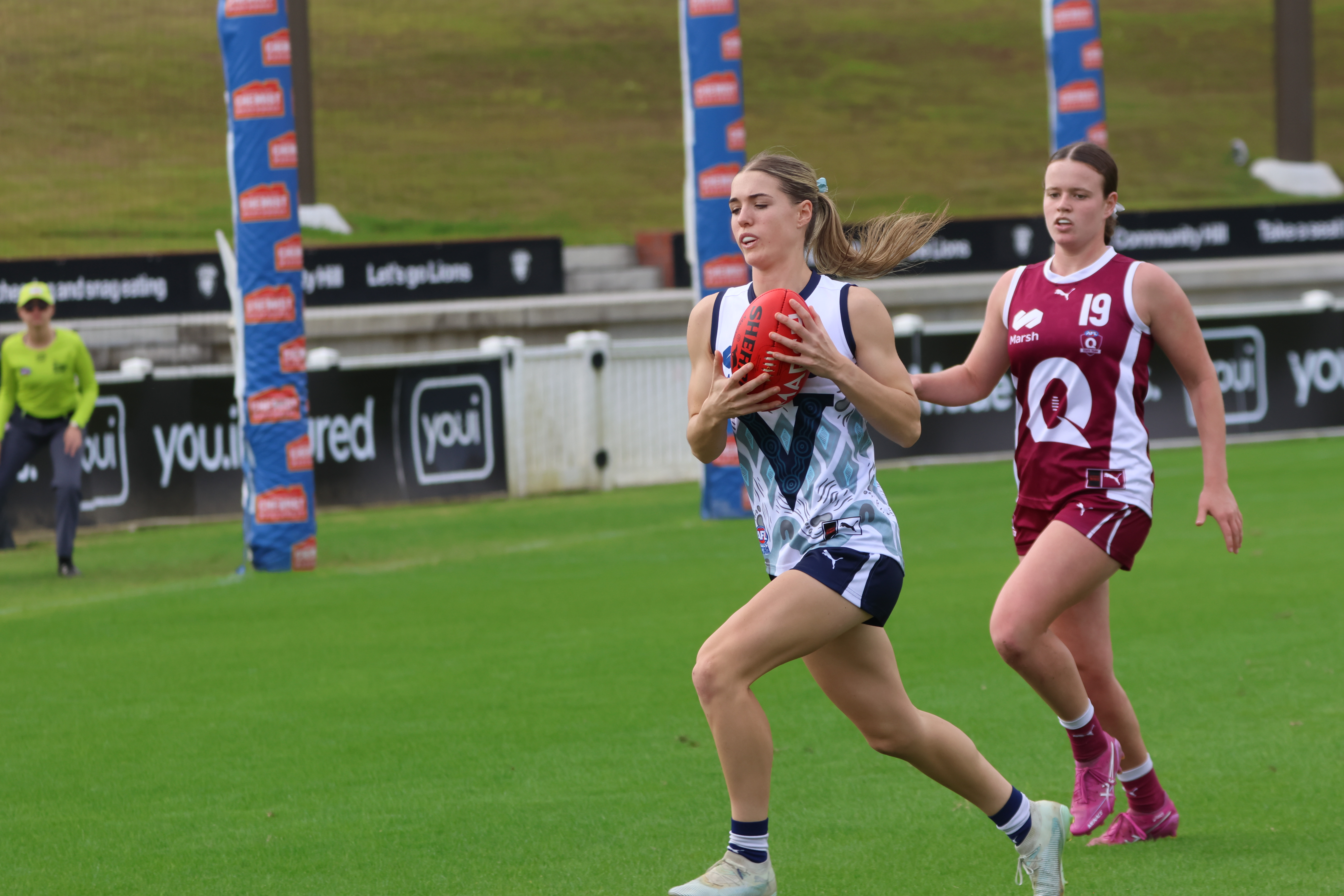
MURRAY Bushrangers came away with a handy 30-point win over Tasmania Devils in a battle of the second and third placed Country Division sides at Highgate Recreation Reserve on Sunday, running out 8.10 (58) to 4.4 (28) winners in Round 18 of the Talent League Girls. At the centre of it was Skylah McPherson, the […]
Purple Patch: McKeegan grounds Jets in four-goal blitz
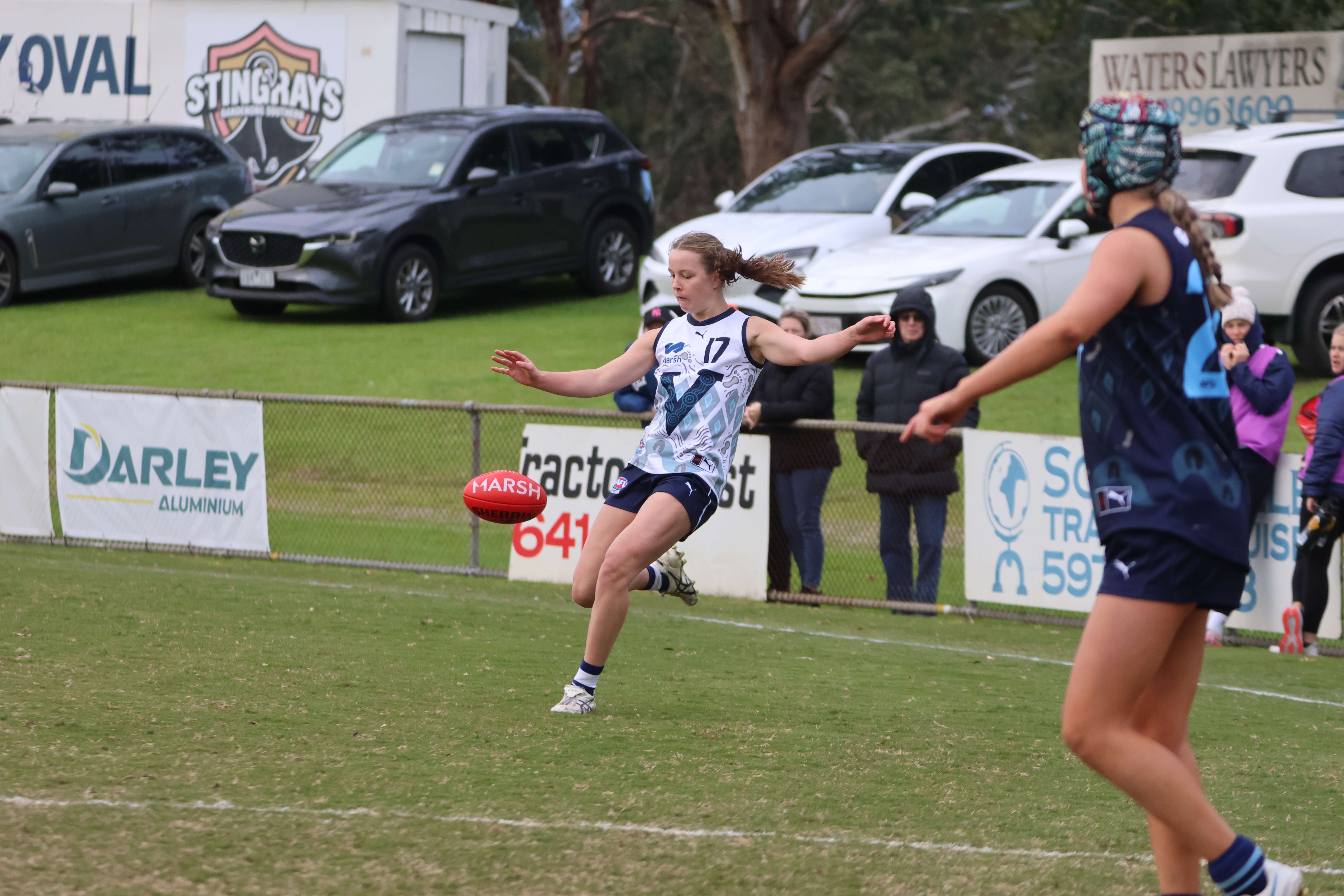
GEELONG Falcons talent and National Academy member Greea McKeegan has always threatened to be that match-winning star, having produced consistent performances at a solidly high level over the past 18 months. However in what was her most impactful performance to-date, McKeegan slammed home four goals and aided in her side’s two others to quite literally […]